
GPS Tracker for Trailers & Equipment
4.1Editor score
Up to five-year battery life
Wireless tool-free installation
Waterproof construction-grade design
Explore the best satellite based asset tracker for equipment, comparing battery life, durability, coverage, alerts, installation, and tracking features.
Tracking valuable equipment across job sites, yards, remote work areas, or long transport routes requires more than a basic location tag. A capable asset tracker should combine dependable positioning, long battery life, rugged construction, useful alerts, and a service that remains active when cellular reception is unreliable.
This guide compares ten trackers marketed for vehicles, trailers, machinery, construction assets, containers, boats, and other valuable equipment. The comparison considers power options, mounting methods, update frequency, waterproofing, alert capabilities, geographic coverage, and whether the device uses cellular, Wi-Fi-assisted, or satellite communication.
Each review explains the strongest reasons to choose a tracker, along with meaningful limitations and the types of assets for which it appears best suited. Product specifications and service terms can change, so readers should verify the current feature set, coverage, subscription conditions, and accessories directly before purchasing.
4.1Editor score

4.1Editor score

4.0Editor score
The table below highlights the major differences among the ten trackers, including their power approaches, ruggedness, positioning methods, alert features, and ideal equipment applications.




The LandAirSea Overdrive earns the top position because it combines fast location reporting, a large 4240 mAh battery, flexible installation, and a broad feature set in a compact magnetic package. Its 4.1 rating reflects a generally capable tracker designed for trucks, trailers, construction equipment, recreational vehicles, and other critical assets.
We may earn a commission when you buy through this link, at no additional cost to you.
Its standout strength is reporting speed. Location updates can occur as frequently as every three seconds, while historical playback is available for up to one year. The web-based platform and SilverCloud App support Google Maps, geofencing, email alerts, dark mode, customizable operating modes, and location sharing through ShareSpot. Motion activation helps the device sleep when an asset remains stationary, preserving power without requiring the owner to manage the tracker manually.
The tracker is built around a 4240 mAh battery, which LandAirSea says lasts three to four times longer than its LandAirSea 54. The IP67-rated housing is waterproof and includes a strong magnetic attachment for fast deployment. International tracking is advertised in more than 155 countries, although users still need a compatible cellular service where they operate.
This is the most balanced choice for owners who want detailed, near-real-time visibility without a hardwired installation. The main trade-off is the required per-device subscription. It is best suited to actively managed vehicles, rental equipment, and fleets that benefit from frequent reporting, while less active assets may be better served by a longer-life low-frequency tracker.
Three-second reporting provides a responsive view of movement, making the Overdrive useful for route checks, utilization reviews, and geofence response. One year of playback also gives owners a substantial history for reconstructing how equipment moved.
The integrated magnet makes the tracker easy to attach to a steel surface or place in a protective housing. A hardwire kit is optional for continuous operation, but it is unnecessary when wireless deployment and automatic sleep behavior are preferred.
We may earn a commission when you buy through this link, at no additional cost to you.
The Optimus 3.0 has a 4.3 rating, the highest among the ten products, and presents a compact, straightforward option for owners who need quick magnetic deployment. It is marketed for vehicles, machinery, valuables, and other assets that can be monitored within the United States, Canada, and Mexico.
We may earn a commission when you buy through this link, at no additional cost to you.
The default one-minute reporting mode can provide up to two months of battery life. Users who require more immediate information can configure position updates as frequently as every ten seconds, creating a useful balance between visibility and power consumption. The tracking software supports live viewing and custom instant alerts delivered through text message and email.
Its twin magnet case is one of the more useful physical features for temporary or portable deployments. It can be placed on a metal surface without complicated wiring, making it convenient for swap-outs between equipment, rental units, or vehicles. The product's compact form also helps reduce the visual impact of the tracker.
The Optimus 3.0 is a sound choice for North American users seeking a simple tracker with frequent reporting and a strong customer rating. Its geographic limits are the most important consideration: owners with assets traveling internationally need to verify service availability before relying on it. The required subscription should also be factored into the operating plan.
The ability to move from a one-minute default to ten-second updates makes the tracker adaptable to short-duration movements. Frequent reporting is useful during a delivery or workday, while slower updates can preserve battery when extended tracking matters more.
The magnetic case allows the same tracker to be redeployed without tools or permanent modifications. That flexibility is particularly useful for rental businesses, contractors moving machines, or owners tracking several assets in rotation.
We may earn a commission when you buy through this link, at no additional cost to you.
The GPS Tracker for Trailers & Equipment is built around a compelling proposition: up to five years of operation on a single battery. Its 4.1 rating and focus on unpowered assets make it especially interesting for trailers, generators, containers, construction equipment, and rental inventory that spends long periods parked or operating without a reliable power source.
We may earn a commission when you buy through this link, at no additional cost to you.
Installation is straightforward because the device needs no wiring, drilling, or electrical connection. A waterproof housing suits outdoor deployment, while web and mobile applications provide location history, movement records, utilization information, and theft-recovery assistance. These features suit owners who need proof of location and a broad operational record rather than a continuous live map.
The product deliberately avoids the complexity of live tracking, which helps the battery last much longer. That is an advantage for assets stored in yards, job sites, or customer locations, where frequent reporting may add little value. Subscription plans are described as flexible, with no minimum commitment, long-term agreement, or cancellation penalty.
This is the best value-oriented choice for long-term asset visibility and simple wireless installation. It is not the right selection for an owner who needs continuous, second-by-second location visibility. For periodic location history and long unattended deployments, however, its battery-focused design is exceptionally practical.
The five-year battery target is the central advantage for equipment without a dependable power source. It reduces the likelihood of routine charging or wiring work, particularly when many units must be deployed across a yard or rental fleet.
Because installation requires no electrical work, operators can add devices to mixed equipment more quickly. A consistent, tool-free approach is especially useful when tracking tags must be moved among trailers, generators, and rental machines.
We may earn a commission when you buy through this link, at no additional cost to you.
The LandAirSea 54 is a compact, magnetic tracker with a 4.1 rating and a feature set focused on rapid reporting and discreet deployment. It is designed for vehicles, ATVs, golf carts, and other critical assets, making it a familiar option for owners who want a small unit that can be attached in seconds.
We may earn a commission when you buy through this link, at no additional cost to you.
The tracker can update its location as quickly as every three seconds and supports real-time alerts, geofencing, and Google Maps viewing through web software or the SilverCloud App. Historical playback extends for up to one year. Motion activation causes the device to sleep when it is not moving, which reduces power consumption during periods of inactivity.
An internal magnet is a major practical advantage because it eliminates the need for external brackets or exposed fasteners. The unit is waterproof and designed for outdoor use, while its small size makes it easier to conceal. LandAirSea also supports customers in the United States and offers a lifetime warranty for manufacturing defects during normal use.
The LandAirSea 54 is most attractive for users who prioritize a small footprint, simple magnetic placement, and flexible reporting over maximum battery capacity. A per-device subscription remains mandatory. Buyers should also review its current environmental rating and compare it with newer LandAirSea models if severe exposure or continuous operation is expected.
The internal magnet leaves fewer external components visible and allows the tracker to sit close to a steel surface. This makes it practical for temporary monitoring and reduces installation time.
Motion-triggered sleep allows the tracker to preserve power while parked. When movement resumes, it can return to an active reporting pattern without requiring a manual recharge cycle for every short trip.
We may earn a commission when you buy through this link, at no additional cost to you.
The Trak-4 portable tracker combines a long operating interval with international cellular coverage and a useful Wi-Fi positioning fallback. Its 4.1 rating reflects a durable device aimed at vehicles, equipment, assets, and other mobile property, with 12 to 18 months of operation per charge when reporting daily.
We may earn a commission when you buy through this link, at no additional cost to you.
The internal LiPo battery is the defining advantage. Trak-4 states that its capacity delivers many times the endurance of smaller round trackers. It supports 4G LTE worldwide tracking and can fall back to 2G networks where newer cellular service is unavailable, adding resilience across different regions and local network conditions.
Wi-Fi-based location technology provides another layer of accuracy when GPS signals are blocked inside buildings. This combination is useful for equipment stored in warehouses, covered yards, or multi-level facilities where a conventional GPS-only tracker may report a less precise position. The housing is waterproof and designed for rugged outdoor use.
This is a strong selection for owners needing broad geographic support and long battery life without a permanent power connection. A subscription is required, and precise real-time behavior still depends on cellular coverage and the selected reporting configuration. It is particularly useful for internationally traveling assets that regularly enter built-up areas.
Wi-Fi-assisted location is a meaningful advantage when equipment is indoors or under substantial cover. It complements GPS and can help users identify a more useful location than an unavailable satellite fix.
A 12-to-18-month operating interval at daily reporting reduces charging frequency. That makes the tracker appropriate for equipment moved between locations or monitored without access to a standard power outlet.
We may earn a commission when you buy through this link, at no additional cost to you.
The SPOT Trace is the clearest true satellite option in this roundup. Its 4.0 rating and Globalstar-based satellite technology distinguish it from the cellular trackers, making it especially relevant for equipment traveling through remote areas where a conventional mobile network may not provide a usable connection.
We may earn a commission when you buy through this link, at no additional cost to you.
SPOT Trace uses GPS to determine a location and then transmits those coordinates through satellite technology. It can send status messages, be programmed to report at waypoints, and allow users to notify contacts or emergency services with exact GPS coordinates. This makes it useful for moving trucks, boats, luggage, backpacks, and vehicles in areas where the tracker's own cellular network would be an unreliable assumption.
The package includes the tracker, four AAA lithium batteries, a USB power cable, and a quick-start guide. Activation requires selecting one of two service plans. Rather than being designed primarily as a continuous live map, the device emphasizes scheduled or waypoint communication, which can be more appropriate for remote expeditions and long-distance travel.
The SPOT Trace is the premium selection for buyers whose highest priority is satellite reach rather than continuous cellular tracking. It is less suitable for fleet managers expecting a constantly updating live map, but it fills an important gap by maintaining communication where cellular trackers can fail. Users should select the service option that matches their reporting and message needs.
Satellite transmission allows the tracker to send location information in places where cellular data services are absent or unreliable. This is its defining advantage for remote work and off-road travel.
The device can communicate GPS coordinates to selected recipients and support emergency notification workflows. Preprogrammed waypoint reporting also reduces the need for continuous updates when only periodic position confirmation is useful.
We may earn a commission when you buy through this link, at no additional cost to you.
The Lonestar Tracking Barra is built for demanding equipment environments, combining an IP68 and IK07-rated housing with replaceable batteries, multi-GNSS positioning, and 4G/5G connectivity. Its 4.0 rating suits a product that emphasizes rugged construction, security alerts, and operational continuity over ultra-rapid live reporting.
We may earn a commission when you buy through this link, at no additional cost to you.
Two batteries allow the Barra to remain in service while another is being replaced. Depending on the reporting pattern, the manufacturer advertises up to eight years with daily updates, three years with movement-based tracking, and two years with hourly tracking. Low-battery alerts and recovery mode help owners manage the power system and maintain coverage during a swap.
The tracker supports GPS, GLONASS, Galileo, and BeiDou, with cell-tower backup when a GNSS signal is unavailable. Its active reporting interval can be every five minutes while moving and longer while stationary. Alerts cover geofence breaches, suspected theft, tip detection, run hours, impacts, and tampering. Onboard flash memory stores location records out of range and uploads them when service returns.
The Barra is a strong fit for contractors, rental operators, and owners of equipment exposed to impacts or weather. Its stated cellular coverage includes the United States, Canada, and Mexico, so it is not the right choice for a globally deployed fleet without checking service in each destination. The slower moving update also makes it less suitable for minute-by-minute route monitoring.
User-replaceable batteries are valuable when a tracker cannot remain offline while power is changed. The internal battery set also supports long deployments when reporting frequency is moderated.
Impact, tip, run-hour, low-battery, and tamper events can all generate alerts. This broad event coverage gives owners more context than a basic location-only tracker.
We may earn a commission when you buy through this link, at no additional cost to you.
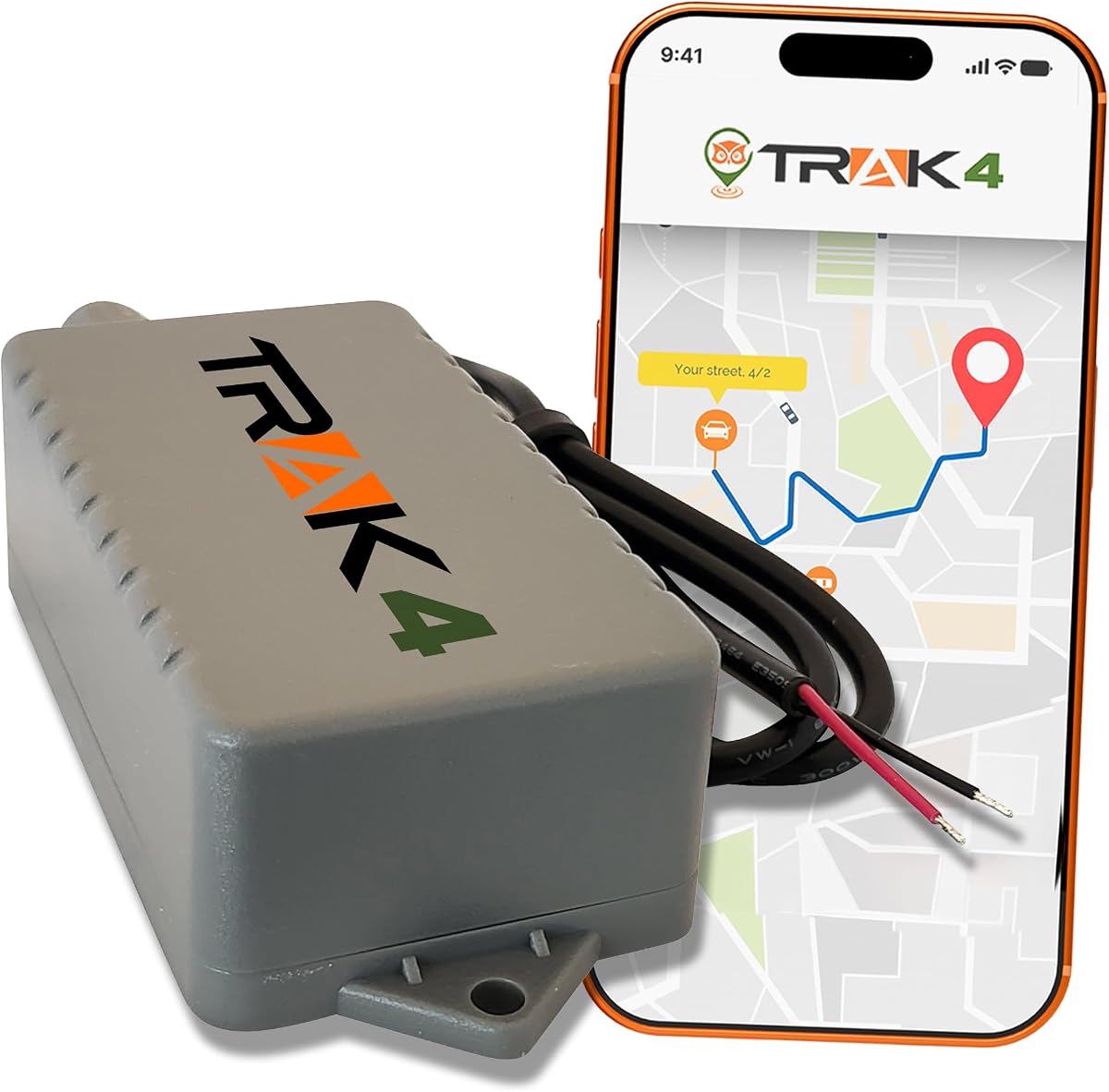
The Trak-4 12v hardwired tracker is intended for owners who can install a permanent power connection and want continuous operation without regular charging. Its 4.1 rating reflects a durable commercial-grade device designed for vehicles, trailers, construction equipment, fleets, and other assets.
We may earn a commission when you buy through this link, at no additional cost to you.
A two-wire harness connects to a 12-volt source and continuously trickle-charges the internal battery. If the connection is interrupted, the internal battery can keep tracking for up to 12 to 18 months with daily pings. This creates a resilient installation that continues reporting even after a wiring problem or temporary loss of vehicle power.
The tracker supports 4G LTE coverage in about 100 countries, with GPS and GLONASS positioning. When satellite reception is blocked indoors or under cover, it can use Wi-Fi positioning. While moving, reporting can occur every 30 seconds; when parked, it checks in daily. SMS and email alerts can cover geofence crossings, speed, motion, power disconnection, and low-battery conditions.
This is the strongest option for a fixed fleet installation where vehicles or equipment run regularly and have access to a 12-volt system. The main drawback is installation complexity compared with magnetic and solar alternatives. Although the backup battery adds resilience, the tracker still depends on an active cellular subscription and compatible coverage for routine communications.
Trickle charging keeps the tracker ready for real use while the internal battery provides a substantial safety net. This is especially useful for equipment that operates long shifts and must remain observable after power is disconnected.
Frequent updates while moving can support route analysis, while daily parked check-ins reduce unnecessary traffic. Owners can select a schedule that reflects how intensively each asset needs to be monitored.
We may earn a commission when you buy through this link, at no additional cost to you.
The Trak-4 Solar stands apart with a built-in solar panel that keeps its battery charged without wiring or plug-in charging. It is designed for outdoor equipment such as trailers, containers, boats, and machinery, and its 3.8 rating is the lowest in the group, making careful consideration of environmental conditions important.
We may earn a commission when you buy through this link, at no additional cost to you.
The solar system works best when the device receives at least 20 hours of good sunlight each week. This requirement makes the tracker better suited to open-air assets than equipment permanently stored under roofs or inside opaque containers. Once charged, the cellular service plan provides daily check-ins, movement start and stop reports, or hourly updates while moving.
Tracking is carried over a dedicated 4G LTE cellular connection using LTE-M coverage in about 100 countries, including the United States. Unlike Bluetooth tags, the device does not need a nearby phone to relay information. Geofence entry and exit alerts and low-battery notifications can be delivered by SMS or email through mobile applications or a web browser.
Installation is flexible, with screw mounts, double-sided tape, and built-in slots for zip ties, straps, or harnesses. An optional magnet kit allows placement on steel surfaces. The tracker is a compelling choice for exposed assets that receive reliable sunlight, but users should confirm the panel is not shaded by a trailer wall, storage cover, or dense canopy.
The integrated panel reduces dependence on external charging and wiring. It is especially helpful for long-lived deployments on trailers, containers, and boats that remain exposed to sunlight.
Screw, tape, strap, and optional magnetic mounting options make it easier to match the tracker to different surfaces. This is valuable when equipment moves or deployment conditions vary.
We may earn a commission when you buy through this link, at no additional cost to you.
The Brickhouse Security EON Odyssey has a 5.0 rating, the highest customer rating in this comparison, and combines real-time tracking with a distinctive light sensor. It is designed for vehicles, equipment, and other valuable assets where a simple magnetic mount and removal detection add practical security.
We may earn a commission when you buy through this link, at no additional cost to you.
At the most frequent one-minute reporting setting with one hour of daily driving, the rechargeable battery can last up to 45 days. With only one location ping per day, that interval can extend to as much as 16 months. The tracking platform is accessible from a phone, tablet, or computer and provides movement, speed, and geofence notifications.
Its built-in light sensor can detect when the tracker is moved or removed and send an alert. This feature adds a layer of security beyond ordinary geofencing. The enclosure also includes a high-strength magnet and integrated strap loops, allowing placement on trailers, vehicles, machinery, and other assets without permanent modification.
The EON Odyssey is best for owners who want a strong customer rating, a flexible mounting system, and real-time security notifications. Its most impressive battery result depends on reporting only once per day, so buyers who need continuous minute-by-minute visibility should expect more frequent charging. The tracker also requires an active subscription.
The light sensor can identify movement or removal that a conventional movement alert might not explain. It gives owners a useful signal when a tracker is disturbed or taken from a concealed position.
The high-strength magnet supports quick placement on steel surfaces, while integrated strap loops provide an alternative for other assets. This flexibility makes the tracker easier to deploy across mixed fleets.
We may earn a commission when you buy through this link, at no additional cost to you.
The right asset tracker depends on where equipment operates, how frequently it moves, what level of visibility is needed, and whether a permanent power connection is practical.
In short, confirm that the communication network serves every region where the asset will travel.
Choose the reporting schedule first, then select a battery system that can sustain it.
Match the power method to how often the equipment runs, where it is stored, and who performs maintenance.
Check both ingress and impact ratings, then match them to the harshest expected environment.
Prioritize the events that matter for your assets instead of selecting a tracker solely by update speed.
Review country coverage, network generations, roaming behavior, and any service-plan restrictions before deployment.
Choose a mounting method that balances tamper resistance with the need for quick redeployment.
Confirm plan terms, included features, and cancellation rules before deploying a tracker to every asset.
Begin by charging the tracker according to its instructions, activating the compatible service plan, and confirming that it appears in the associated web portal or mobile application. Test the device indoors and outdoors before attaching it to important equipment. Verify the reported position, account settings, alert recipients, geofences, and update schedule while you still have easy access to the unit.
Install the tracker on a clean, dry, stable surface using the appropriate magnetic, adhesive, strap, screw, or hardwired method. Give cellular antennas and solar panels an unobstructed view, and keep the device away from metal structures that could block signals. If using geofences, set boundaries around job sites, storage yards, depots, and other expected operating areas, then create a notification process for every relevant alert type.
Inspect the tracker and mounting hardware regularly, particularly after severe weather, impacts, maintenance, or battery replacement. Clean dirt and moisture from the enclosure, verify that seals remain intact, and check that alerts still arrive. Review location history periodically to confirm that the reporting schedule remains appropriate, and replace or recharge the battery before long deployments when the device will not receive regular maintenance.
No. Most products use satellite positioning systems such as GPS to determine a location, then transmit that information through a cellular network. The SPOT Trace is the primary exception because it uses Globalstar satellite technology to transmit location and status messages. A cellular tracker is usually better for detailed live maps, while the satellite option is more valuable where mobile coverage is absent or unreliable.
The GPS Tracker for Trailers & Equipment is specifically designed for assets without a dependable power source, offering up to five years of battery life and a wireless installation. The Trak-4 Solar can also suit an exposed trailer when it receives strong sunlight. The best choice depends on whether long standby endurance or renewable charging is more important.
All ten products listed require an active service plan for each device. Plans generally provide the communications connection, platform access, location transmission, and alert functions. When comparing options, review the reporting frequency, geographic coverage, historical data access, cellular allowances, contract terms, and cancellation rules included with each plan.
Yes, and several products are specifically marketed for construction machinery, rental fleets, trailers, and heavy equipment. The Overdrive, LandAirSea 54, Trak-4 hardwired model, and Barra are especially relevant because they offer strong mounting options, rugged housings, alerts, and frequent reporting. The correct choice still depends on power availability, update frequency, and cellular coverage at each job site.
Frequent reporting is useful for moving vehicles, active rentals, and rapid theft response, while daily check-ins or movement events are more efficient for stored equipment. Devices can offer reporting intervals ranging from several seconds to hours or days. Select a schedule based on the asset's activity, battery capabilities, and the urgency of each alert.
It depends on the positioning method and nearby communications coverage. GPS can be weak indoors, but the Trak-4 models include Wi-Fi-assisted positioning, and the Barra uses multi-GNSS with cell-tower backup. A tracker may still be able to estimate a location from nearby wireless networks, though accuracy can differ from an open-sky GPS fix.
A magnetic tracker is quick to deploy and works well for temporary monitoring, but it can be easier to remove than a screwed, strapped, or hardwired installation. The Barra adds tamper detection, while the EON Odyssey includes a light sensor that can detect movement or removal. For high-value equipment, combine a secure mount with geofence, motion, and tamper alerts.
Charge it fully, activate the required plan, and confirm that the account receives a current location. Test motion alerts, geofences, and notification delivery before mounting the device. Once installed, inspect the attachment, confirm that the account continues updating, and schedule periodic checks of battery condition, location history, and alert response.
The LandAirSea Overdrive is the strongest all-around recommendation for owners who need fast reporting, a large battery, magnetic installation, geofencing, and detailed historical playback. The GPS Tracker for Trailers & Equipment is the practical value choice for unpowered assets that need long-term monitoring, while the SPOT Trace is the leading premium option when true satellite communication is essential.
The right tracker for a particular fleet may instead be the Barra for rugged construction and tamper alerts, the hardwired Trak-4 for continuous vehicle power, the Solar Trak-4 for exposed assets with strong sunlight, or the EON Odyssey for removal detection. Prioritize communication coverage, realistic battery behavior, environmental durability, and the alerts required to support your operations before comparing smaller differences in the interface.
Product availability, service-plan terms, supported regions, and included accessories can change over time, and purchase conditions may also vary. Before ordering, verify the current tracker specifications, subscription requirements, reporting schedules, and accessories directly with the seller, then choose the model that best matches the equipment and the locations where it must remain visible.